
Modern customs and border security operations demand technological frameworks that are both highly secure and adaptable to evolving threats. To ensure advanced AI capabilities can be seamlessly integrated across diverse operational environments, CustomAI has reached a major milestone: completing the high-level technical architecture specification and design for the project.
Developed over 12 months through close collaboration among CustomAI’s technical, academic, and industrial specialists, this technical foundation is designed to support the project’s three core pilot domains:
- Airport cargo and parcel inspection
- Seaport container inspection
- Cultural goods protection
The primary goal of this work was to design a scalable, resilient, and technology-agnostic architecture—one engineered to handle complex operational data streams without disclosing sensitive implementation details.
An Optimized IoT–Edge–Cloud–UI Continuum
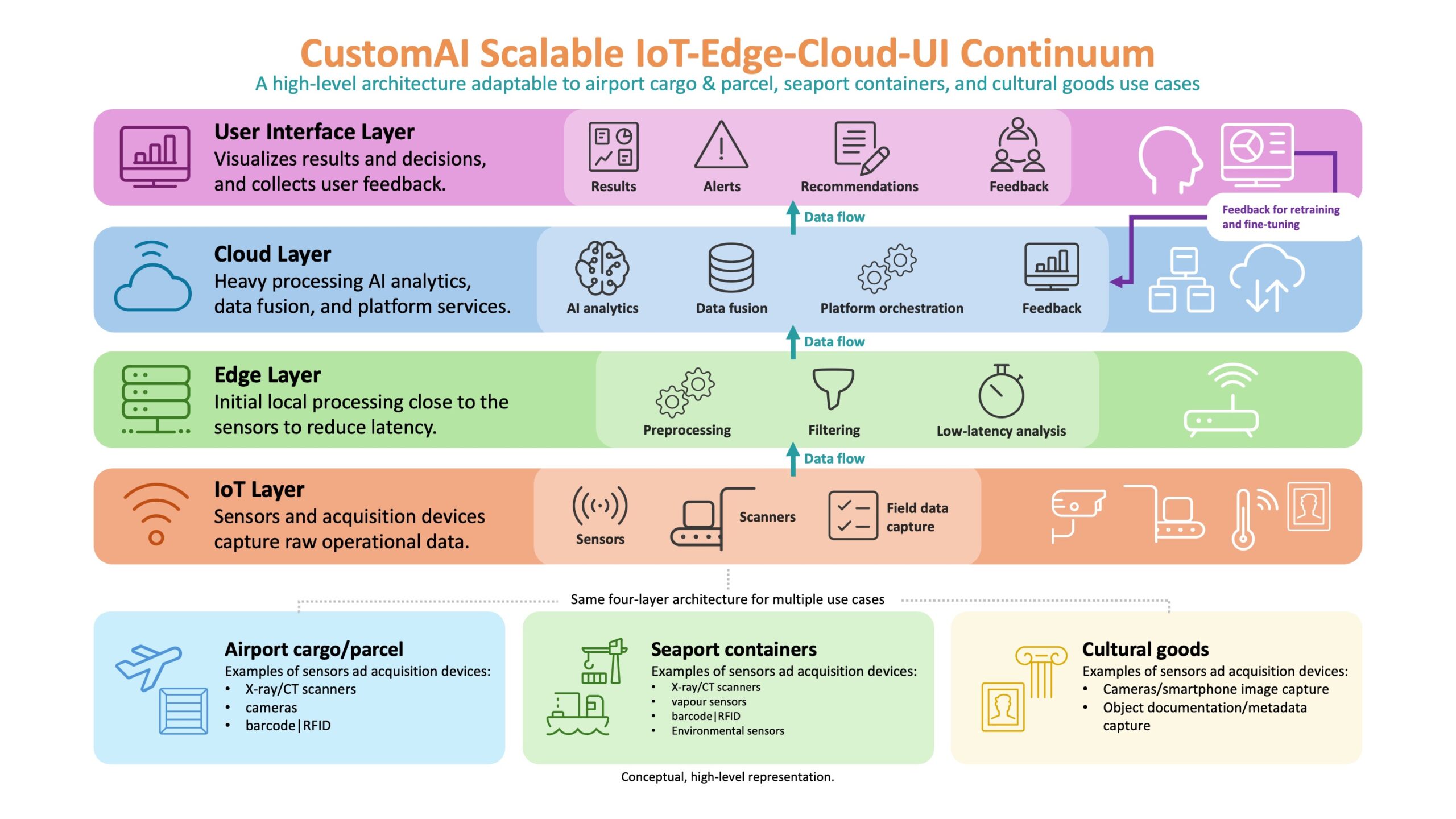
At the heart of the CustomAI technical design is a multi-layered continuum that connects physical sensor data directly to officer decision-making:
- IoT Layer: Draws on domain-specific tools—such as X-ray and CT scanners, cameras, barcode/RFID readers, vapour samplers, environmental sensors, and specialized image acquisition tools—to capture raw operational data required for customs risk analysis.
- Edge Layer: Performs preliminary data filtering, preparation, and low-latency analytics close to the point of capture, reducing delays for time-critical actions while respecting edge hardware constraints.
- Cloud Layer: Hosts advanced AI services, data fusion, orchestration, and heavy analytical processing, synthesizing information from multiple sources to generate enriched intelligence and decision-support alerts.
- User Interface (UI) Layer: Delivers actionable insights to customs officers, allowing them to review recommendations, visualize findings, and provide operational feedback that continuously fine-tunes and retrains system models over time.
Grounded in Practical Operational Needs
To ensure the architecture was anchored in real-world operational realities, the team conducted structured stakeholder workshops to capture functional and non-functional requirements, identify operational gaps, and align technical specifications with international interoperability standards and security best practices.
Rather than serving as a static diagram, the finalized technical specification establishes a live, evolving reference model across all three pilot use cases.
Key Highlights
- Scalable & Technology-Agnostic: A modular baseline designed for system integration without exposing sensitive implementation details.
- Three Targeted Pilot Domains: Tailored directly to airport cargo, seaport containers, and cultural goods protection.
- End-to-End Continuum: Full integration from physical sensors through cloud-based AI orchestration to interactive officer dashboards.
- Continuous AI Refinement: Built-in human-in-the-loop feedback mechanisms to continuously retrain and fine-tune decision-support models over time.
Looking Ahead: Moving from Design to Execution
With the architectural foundation established, the project smoothly transitions into active technical execution:
- Toolkit Development & Integration: The defined framework forms the blueprint for active development and integration of the core CustomAI toolkit.
- Data Interoperability: The baseline establishes the structural interfaces and data flow parameters required for knowledge repository design and data sharing.
- Pilot Environment Setup: By defining precise component interfaces, the architecture sets the stage for configuring test environments across all pilot sites and setting benchmarks for evaluation.